

The following discussion is educational and is not medical advice. It does not imply a physician-patient relationship, nor is anything discussed herein intended to advocate for any specific medical treatment or therapy, or to replace standard accepted medical care by a trained healthcare professional. If you are injured or ill, seek immediate and definitive care from a licensed professional.
There is no Golden Hour where we live.
Many of the protocols we learn in healthcare, such as ACLS, TCCC, PALS, and ATLS, assume immediate access to surgical teams and hospitals with near-infinite resources and multispecialty support. Austere medicine operates on the premise of practicing medicine without modern, resource-rich infrastructure. Prolonged Casualty Care, or PCC, is becoming more common as near-peer or peer-to-peer conflicts reduce the ability to rapidly evacuate casualties for definitive care. The Joint Trauma System defines prolonged casualty care (PCC) as the need to provide patient care for extended periods when evacuation or mission requirements surpass the available capability to provide it. In plain terms: the helicopter is not coming.
You may find yourself the most qualified medical personnel your patient sees for several days. But no matter what we call it, sound medical principles, fundamental nursing practice, and the US standard of hospital care can still be applied to effect positive outcomes for your patients.
This will be the first in a series on austere wound care and will apply the above Fundamentals; this Dispatch covers wound cleaning and irrigation, fundamental nursing care, dressing considerations, and debridement issues.
What Changes When Evacuation Is Measured in Days or even Weeks?

- Unless available on-site or through telemedicine, you inherit and own decisions usually deferred to a surgeon.
- Once hemostasis is achieved, your biggest struggle becomes infection control.
- Consumables become reusables. You may need to get creative with materiel used for dressings and wound care when your logistics chain disappears. Mastery of the basic principles of water processing will be central to operating a safe aid station.
How Do You Clean a Wound in the Field?
A wise old trauma attending once said, "Dilution is the solution to pollution." Irrigation is the single most important intervention you can control. The goal is mechanical removal of dirt, foreign objects, and bacteria from the wound. Which solution and method you use depend on circumstances, but we can fall back on sound core principles with literature evidence from Wilderness and Environmental Medicine and Army literature from the Joint Trauma System.
In the absence of sterile saline, The Wilderness Medical Society's guidelines list potable water as the preferred irrigation fluid in the austere setting, whereas military prolonged field care guidance grades the irrigation ladder as: Dakin's solution or sterile isotonic solution (BEST), clean potable tap water (BETTER), and the cleanest water available (MINIMUM) — while the military war-wounds guideline finds normal saline, sterile water, and potable tap water to have comparable efficacy. If the water is not potable, boil it for at least 3 minutes and let it cool before using it to irrigate the wound. Current evidence does not support additional treatment with iodine, bacitracin, or antibiotics in the fluid, as no benefit has been documented.
Literature consensus on how much fluid to use for wound irrigation varies, with standard military guidance advocating 1-3 L for small wounds, 4-8 L for medium-sized wounds, and 9 or more L for large, heavily contaminated wounds. This is far more water than you will likely carry in your ruck, which is why knowledge and experience with competent water-processing techniques are critically important when operating an austere clinic.
Recommendations on the amount of pressure to use when irrigating the wound also differ. The literature and doctrine for military war-wound guidance advocate simple bulb-syringe or gravity irrigation and note that very high pressures confer no additional benefit and can damage tissue. Whereas literature from wilderness medicine journals recommends higher-pressure irrigation (a syringe through an 18-gauge catheter). Our medical practice in austere environments uses potable water, or U.S. standard tap water at a pressure of 6-12 PSI. This can usually be obtained by piercing a plastic bottle with an 18-gauge needle.
How Do You Dress an Open Wound When the Hospital Is Days Away?
Cover the cleaned wound with a non-adherent contact layer against the tissue and a secured absorbent outer layer — that construction, endorsed in the 2026 international war-wound consensus, protects the wound bed and lets you inspect it without causing damage. Current JTS prolonged casualty care nursing guidance is explicit: inspect at least every 24 hours, change soiled dressings, and keep everything clean and dry. When supplies are critically short, the minimum standard is to reinforce and secure the original dressing rather than change it completely. Unnecessary dressing changes cost supplies and possibly delay wound healing. Open wound care in prolonged casualty care is scheduled, not as needed.
The Wet to Dry Dressing, a Field Workhorse
Negative pressure wound therapy works in the controlled environment of the hospital; it is VERY challenging to maintain properly in austere environments. The key quality this system delivers is continuous removal of wound exudate and dead tissue. In field/austere environments, this can also be accomplished with the time honored wet-to-dry dressing.

-
Soak
Soak the wound packing (the author LOVES Kerlix) in sterile water (boiled water or commercially packaged sterile saline).
-
Wring
Wring out the packing material so it is moist, not dripping wet.
-
Pack
Pack the wound cavity and cover with dry dressings.
-
Secure
Secure the dressing.
-
Remove and Inspect
After 24 hours, remove the wound packing carefully. It will stick to and remove dead tissue, debris, and wound exudate (drainage). If it is TOO dry and removing it may cause bleeding, simply soak the wound packing material with sterile water to loosen it.
-
Repeat
As this process repeats, you should eventually see granulation tissue at the wound base. A clean-appearing wound that is fully granulated can be covered and kept clean.
-
Do Not Confuse
Note this DOES NOT apply to wound packing used to stop bleeding.

Should You Close a Wound in the Field — or Leave It Open?
This is the decision that most cleanly separates the two worlds this series bridges. In the civilian wilderness context, most clean, low-energy lacerations can be safely closed in the field — within roughly 6 hours of injury, up to 10 for the face and scalp. Grossly contaminated wounds should be left open and packed for delayed closure.
War wounds run on the opposite doctrine: high-energy, contaminated wounds are left open, and military guidance is blunt here: avoid closure in the first 48 hours, and in general leave the wound open until you reach definitive care, with the face as the main exception. The variables that decide which doctrine applies to the wound you're treating are mechanism, energy (high or low?), contamination, time since injury, and the austere multiplier of how long you will own this patient and their care. If you close a wound and you are wrong, you will reopen it under suboptimal conditions, possibly without medical backup.
Wound Debridement Outside the Operating Room
Debridement means cutting away dead tissue. Dead tissue is fuel for infection. Medical professionals routinely perform bedside debridement in the controlled environment of the hospital, reserving more complex procedures for the operating room. In austere environments, one usually does not have the luxury of working in a perfectly clean, controlled setting. 2026 consensus guidelines set aggressive timelines for wound debridement.
- immediately for heavily contaminated wounds
- within 12 hours for high-energy injuries
- within 24 hours for everything else.
- Nonviable limbs are treated as tissue for debridement.
But those timelines assume access to a surgeon. Field guidance for the non-surgeon is deliberately conservative: remove obviously nonviable tissue with sharp, clean Instruments, and assess tissue viability using the four Cs — color, contractility, consistency, and circulation. Non-surgeons must be aware of the NO GO ZONES: do not probe penetrating chest wounds, and leave embedded foreign bodies near vital structures for the surgical team. When in doubt, DO NOT CUT. In prolonged casualty care, restraint is a competency. If you are fortunate to have procedural telemedicine back-up, you may be able to perform more aggressive debridement and procedures.
Dakin's Solution: A 1915 Answer to a 2026 Problem
When antibiotics are scarce, and the wound is large, dirty, or already infected, military prolonged casualty care guidance still reaches for a World War I tool: dilute (0.025%) Dakin's solution. Created by British chemist Henry Drysdale Dakin and French physician Alexis Carrel in 1915 to treat deep, dirty battlefield wounds in the pre-antibiotic era, this solution saved countless lives and limbs. Traditional Dakin's solution is a buffered, 0.5% sodium hypochlorite antiseptic that can be mixed in the field from boiled water, household bleach, and baking soda. It is cheap, renewable, and effective as an irrigation and dressing adjunct for the wounds that occur in austere environments.

Field preparation of Dakin's solution (per Joint Trauma System prolonged field care guidance). Half-strength stock: to 1 liter of sterile or boiled water, add 5 mL of plain household bleach (5.25% sodium hypochlorite — unscented, non-gel, no additives) and 1.5 mL of baking soda (or 4 ampules of 8.5% sodium bicarbonate). For irrigation of large, very dirty, or infected wounds, dilute this stock 1:10 with clean water to reach the approximately 0.025% working strength. Mix fresh; label and date the container; discard unused solution within 24 hours. Do not use full-strength bleach or the undiluted stock directly on tissue.
The above recipe is presented for educational purposes only and is NOT medical advice from a physician, nor does it construe a physician-patient relationship. Only use Dakin's solution with a valid physician prescription and under said physician's close supervision.
The precise cautions and clinical judgment around its use are somewhat outside of the scope of this introductory article, but Dakin's solution remains central to the spirit of austere medicine and prolonged casualty care: antibiotic scarcity is not the end of infection control.
Do Field Wounds Need Antibiotics?
When evacuation exceeds 24 hours, military guidance recommends systemic antibiotics for contaminated wounds, either oral or injectable, depending on your patient's condition. Wilderness guidance reserves prophylaxis for high-risk wounds: open fractures, bites, deep contamination. Two disciplines frame the decision to use antibiotics:
- First, tetanus status IS wound care. Vaccination against C. tetani prevents a terrible demise (opisthotonus).
- Second, and this will be covered in this series within our dispatch on sepsis, antibiotics are an adjunct to source control, never a substitute for cleaning, debridement, and drainage of a wound.
Recent TCCC guidance now recommends cefadroxil or cephalexin over moxifloxacin for wounds if the patient can take oral medications. However, the specific antibiotic agents and their doses are clinical decisions for trained providers; the take-home message here is that antibiotics are given AFTER proper wound care, not before.
The Discipline That Holds It All Together
Patient care in the field degrades without a disciplined framework.
The best care to provide in the field environment is the standard of hospital care in the United States or NATO, and we deviate from that standard only because we have to, not because we can. Just because you're in camo and the dirt does not give you a license to do nonstandard medical procedures when you actually could meet the standard of care.
— Prolonged Field Care Podcast 135, at 1:00:28
And whether you're caring for your buddy until search and rescue finds you, or you are a line medic doing prolonged casualty care, the standard of care is the standard of care. YOU are the nurse, and what you do for your patient will pay dividends, or catch up with you, down the road.
Current PCC nursing guidance:
- dressings inspected at least every 24 hours
- limbs distal to splints and pressure dressings checked every 6 hours in the conscious casualty and every 2 in the unconscious
- every finding is documented, so the next provider inherits actionable data and can extrapolate future needs rather than relying on guesswork.
This series of articles will conclude with controlling human factors in austere wound care and include discipline, fatigue, errors, and mental health considerations.
Why This Series, and Why Now
Russia invaded Ukraine; Google searches from Ukrainian territory for tactical combat casualty care rose from a relative search volume of 0.3 to 47.2, signaling an entire population looking for exactly this material. Once a crisis begins, time is short, and the opportunity to build knowledge and competence without severe pressure can be lost. The time to build the knowledge and competence is now.
Over the coming dispatches, this series goes deep on each decision in this framework:
- Tourniquet conversion.
- Early recognition of wound infection.
- Burn stabilization when you can't evacuate.
- Negative pressure wound therapy in austere settings.
- A wound-care loadout.
- Human factors of the long hold.
For the day-one basics of irrigation technique, topical antibiotic use, and penicillin-allergy alternatives, please see Dispatch No. 01, Wound Care in the Field.
Frequently Asked Questions
What is austere wound care?
How do you clean a wound in the field?
Can you irrigate a wound with tap water?
What is a wet to dry dressing?
How do you dress an open wound when help is days away?
Should you close a wound in the field or leave it open?
How often should you change a wound dressing in the field?
What is Dakin's solution and when is it used?
Do field wounds need antibiotics?
What is prolonged casualty care?
References
- Joint Trauma System. Nursing Interventions, Wound Care, and Splint Management in Prolonged Casualty Care (CPG ID: 70), v1.1. July 8, 2025. jts.health.mil (CPG 70 PDF)
- Joint Trauma System. Acute Traumatic Wound Management in the Prolonged Field Care Setting (CPG ID: 62). July 24, 2017. jts.health.mil (CPG 62 PDF)
- Joint Trauma System. War Wounds: Debridement and Irrigation (CPG ID: 31). September 27, 2021. jts.health.mil (CPG 31 PDF)
- Joint Trauma System. Prolonged Casualty Care Guidelines (CPG ID: 91). December 21, 2021. jts.health.mil (CPG 91 PDF)
- Snelling S, Claireaux H, Roocroft H, et al. Clinical guidelines for complex extremity war wound management: update and consensus using a mixed-method approach. BJS Open. 2026;10(1):zraf173. doi:10.1093/bjsopen/zraf173
- Quinn RH, Wedmore I, Johnson EL, et al. Wilderness Medical Society practice guidelines for basic wound management in the austere environment: 2014 update. Wilderness Environ Med. 2014;25(4 suppl):S118-S133. doi:10.1016/j.wem.2014.08.015
- Balda S, Leone T, Veintemilla-Burgos F, et al. The digital echo of war and the influence of tactical combat casualty care on Google search patterns in Ukraine. Discov Health Syst. 2025;4:133. doi:10.1007/s44250-025-00304-9
- Joint Trauma System. Emergency War Surgery Course. Updated April 6, 2026. jts.health.mil/education/ewsc
- Wisniewski P, Becker YA, Larson DT, et al. Antibiotics in Tactical Combat Casualty Care 2025: TCCC Change 25-1. J Spec Oper Med. 2025;25(4):85. doi:10.55460/SW7X-X8ZP
- Prolonged Field Care Collective. Prolonged Field Care Podcast 135. YouTube. Quotation at approximately 1:00:28. Accessed August 19, 2026. youtube.com/watch?v=ZKvS_ieI5l8
Educational content only. Guideline references (Joint Trauma System CPGs, Wilderness Medical Society, BJS Open, and the Journal of Special Operations Medicine) are provided for context. This dispatch is S1, the hub of the AMC Austere Wound Care series.
More From Field Notes
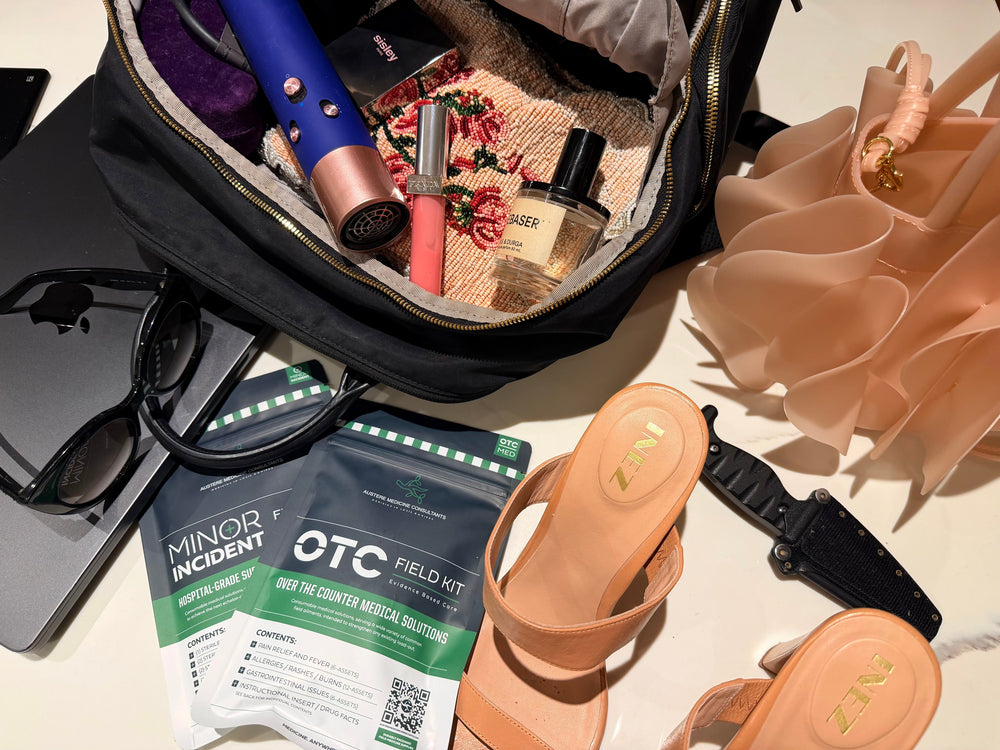
The Physician's Travel Medicine Kit List: What to Pack for Domestic, International, and Expedition Travel.
A physician's travel medicine kit list in three tiers: everyday, international, and austere. What to pack, what needs a prescription, and how to travel with it legally.
Read Article
Tele-Mentorship: Extending (and maintaining) the Standard of Care
Not Medical Advice The following discussion is educational and is not medical advice. It does not imply a physician-patient relationship, nor is anything discussed herein intended to advocate for any specific medical treatment or...
Read Article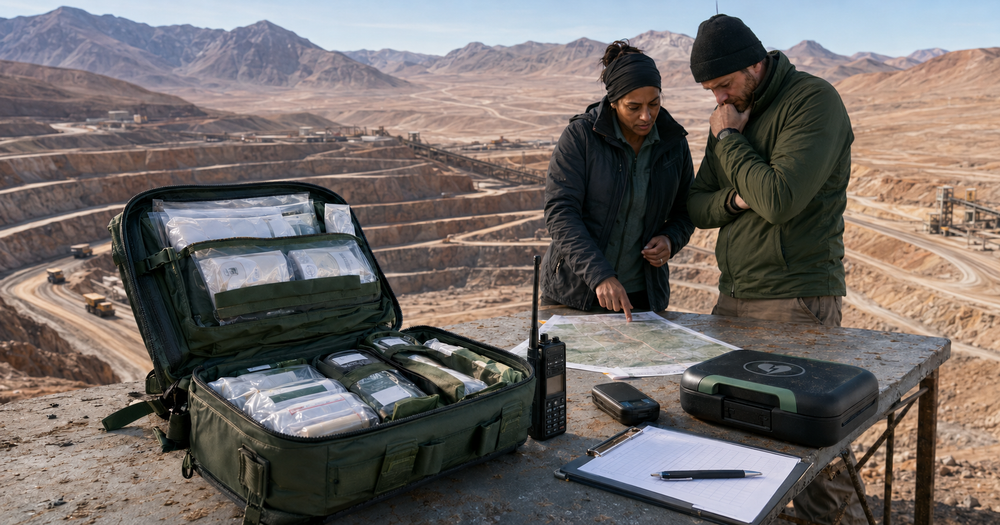
Medical Threat and Capability Assessments: Scope, Deliverables, and When Your Organization Needs One
A first-aid kit is not a medical system. Neither is a telemedicine subscription, an evacuation plan, or a staff member with medical training.
Read ArticleMedicine. Anywhere.
Austere Medicine Consultants brings hospital expertise and capability to the field. Explore physician-built kits engineered for the moments that matter.
Shop the Kits