

Not Medical Advice
The following is an academic discussion of medical topics pertaining to minor lacerations and abrasions. It does not constitute a physician-patient relationship nor is it intended to provide advice, prescribe treatment or replace medical care. If you suffer an injury, please seek immediate and definitive care by a licensed professional.
Introduction
Wound care in the wilderness is different from wound care at home. On the trail, a small cut, blister, burn, or laceration can become a bigger problem when you add sweat, dirt, weather, limited supplies, and delayed access to medical care. This guide explains the basics of wilderness wound care: how to control bleeding, clean and dress a wound, protect it from contamination, recognize warning signs, and decide when evacuation or professional care is needed.
Topical Antibiotics & Triple Antibiotic Ointment
Topical antibiotics have been in use since the medical community discovered sulfa preparations and their use to prevent surgical site infections. Today, triple antibiotic ointment is in wide use and available over the counter. While generally very safe, there are some caveats:
- Topical antibiotics like over the counter neosporin, or triple antibiotic ointment (bacitracin, neomycin, and polymyxin B) are often not necessary for minor, superficial lacerations and abrasions if the wound is properly irrigated with large volumes of clean water (US tap water, sterile saline, properly filtered and purified field water).
- Antibiotic resistance increases yearly and there now exist serious resistance issues, especially in immunocompromised patients (those receiving chemotherapy or immunotherapy, the elderly etc.)
- Although extremely rare, there are reports of serious, fatal, anaphylactic episodes associated with the use of these medications regardless of a prior penicillin allergy.
- Allergies and anaphylactic reactions can occur at any time with repeated use of any medication. Sometimes using the specific ingredients of triple antibiotic ointment together can cause serious contact sensitization reactions.
- Patients allergic to penicillin may have a higher percentage of a cross reaction with the medications in triple antibiotic ointment.

The Science

Wound treatment has been studied throughout history and often parallels experiences from military conflicts. The following is an excerpt from an article from 2002:
“The history of wound care and management closely parallels that of military surgery which has laid down the principles and dictated the practices of wound cleansing, debridement and coverage. From a treatment standpoint, there are essentially two types of wounds: those characterized by loss of tissue and those in which no tissue has been lost. In the event of tissue loss it is critical to determine whether vital structures such as bone, tendons, nerves and vessels have been exposed. It is also important to determine the amount of soft tissue contusion and contamination. In any case primary wound healing by early closure either primarily or with the help of grafts or flaps is preferred to secondary healing and wound contraction with subsequent contractures which interfere with range of motion and function. Whether the wound is acute or chronic, essential principles of wound care must be observed in order to avoid wound sepsis and achieve rapid and optimal wound healing. — Tissues must be handled gently. — Caustic solutions capable of sterilizing the skin should never be applied to the wound. It is desirable never to put anything in the wound that cannot be tolerated comfortably in the conjunctival sac. — All devitalized tissues must be debrided either hydrodynamically, chemically, mechanically or surgically. — All dead space must be obliterated. — Exposed vital structures must be covered by well vascularized tissues. An essential part of any wound management protocol is wound dressing. It cannot be too strongly emphasized that a wound dressing may have a profound influence on healing particularly of secondary type healing, a critical feature being the extent to which such dressing restricts the evaporation of water from the wound surface. A review of available dressing materials is reported with emphasis on the newly developed concept of moist environment for optimal healing. A practical guide for dressing selection is also proposed.”
— Atiyeh, et al
I Got Hurt in the Field! What Do I Do?
If you suffer a small, superficial laceration or abrasion, the medical literature supports the following:
- First stop what you are doing and get to a safe place.
- If you are in the United States, you may clean the wound with LOTS of tap water. If a reliable source of tap water is not available, you may use sterile saline or properly filtered and purified water that you obtained in the field.
- If possible, irrigate the wound with a jet of water. You can fill a plastic bag with clean purified water and create a small hole in the bottom to generate pressure to irrigate the wound. Studies show that there is no difference in the infection rates of superficial wounds receiving irrigation as described above or treatment with triple antibiotic ointment. In fact, medical literature suggests the most effective topical application is medicinal grade honey which is supplied in individual use packets and has no known contraindications.
- After the wound is thoroughly irrigated, apply pressure to stop any bleeding. (Obviously you are not in the MARCH algorithm here, or it would be a MUCH different scenario!) When the bleeding is controlled, wrap the wound with a bandage and keep clean and moist, but not wet. Clean it with purified water a few times a day and whenever it gets dirty.
- Then seek definitive medical care at your physician’s office, urgent care, or emergency department.

But My Cut Looks Infected and I Have Antibiotic Ointment, Can I Use It?
Antibiotic Options at a Glance
- Triple antibiotic ointment (bacitracin, neomycin, polymyxin B) — OTC, generally safe
- Mupirocin — prescription option if penicillin-allergic, when indicated
- Silver sulfadiazine 1% cream — for burns
- Penicillin allergy? Discuss any triple antibiotic with your physician first
Again, current medical literature suggests over the counter triple antibiotic ointment is generally very safe and RARELY causes life threatening allergic reactions. That being said, the same literature supports the following:
- High pressure irrigation with clean water.
- Keeping the wound clean and moist but not wet.
- Speak to your own doctor prior to using any over the counter medication, including topical antibiotic ointments, and specifically discussing your penicillin allergy if one exists.
It is our experience that mupirocin may be used as a topical antibiotic, IF INDICATED, in patients with penicillin allergies or other contraindications to traditional topical antibiotic use. Mupirocin is available by prescription from your physician. It is applicable to minor lacerations and abrasions; while silver sulfadiazine 1% cream is for use with burns. If you are isolated from definitive care and concerned about developing an infection in a small, superficial laceration or abrasion, use over the counter triple antibiotic at your own risk. If you have a penicillin allergy avoid triple antibiotics unless you have previously discussed its use with your own physician.
But What If I Suffered a Large Laceration or Avulsion Injury?
Obviously large, deep lacerations, actively bleeding lacerations, avulsions (the skin separates from your body creating a flap of skin), wounds deep enough to expose muscle, nerves, bone or other structures, or severe burns all require different treatment.
A wound of this type obtained in the field with even the remotest possibility of soil contamination should receive immediate oral or IV antibiotics as prescribed by a physician and you should seek or be rescued by definitive care. Wound care by a physician (or similarly licensed, experienced personnel) including possible surgery(ies), will likely be necessary for full recovery and preservation of function.

In Summary
Minor cuts and scrapes occur often in the field and are usually only inconveniences. Proper treatment with some type of pressurized irrigation with clean water is likely the best treatment.
There are plenty of resources to manage this in the field. In fact, CANA Provisions PDWK is a clever kit that allows its user to filter and purify water AND treat superficial cuts and scrapes! (triple antibiotic ointment included) LINK HERE.
Stay safe out there!
FAQ
Do you need antibiotic ointment for a minor cut or scrape?
How do you clean a wound in the field?
What is the best topical treatment for a minor wound?
Is triple antibiotic ointment safe if I’m allergic to penicillin?
When should I seek medical care for a wound?
References
- Nguyen HL, Yiannias JA. Contact Dermatitis to Medications and Skin Products. Clin Rev Allergy Immunol. 2019 Feb;56(1):41-59. doi: 10.1007/s12016-018-8705-0. PMID: 30145645.
- Kreft B, Wohlrab J. Contact allergies to topical antibiotic applications. Allergol Select. 2022 Feb 1;6:18-26. doi: 10.5414/ALX02253E. PMID: 35141463; PMCID: PMC8822519.
- Bonamonte D, De Marco A, Giuffrida R, Conforti C, Barlusconi C, Foti C, Romita P. Topical antibiotics in the dermatological clinical practice: Indications, efficacy, and adverse effects. Dermatol Ther. 2020 Nov;33(6):e13824. doi: 10.1111/dth.13824. Epub 2020 Jul 12. PMID: 32531105.
- Rodeheaver G, Pettry D, Turnbull V, Edgerton MT, Edlich RF. Identification of the wound infection-potentiating factors in soil. Am J Surg. 1974;128(1):8.
- Stevenson TR, Thacker JG, Rodeheaver GT, Bacchetta C, Edgerton MT, Edlich RF. Cleansing the traumatic wound by high pressure syringe irrigation. JACEP. 1976;5(1):17.
- Atiyeh BS, Ioannovich J, Al-Amm CA, El-Musa KA. Management of acute and chronic open wounds: the importance of moist environment in optimal wound healing. Curr Pharm Biotechnol. 2002;3(3):179.
More From Field Notes
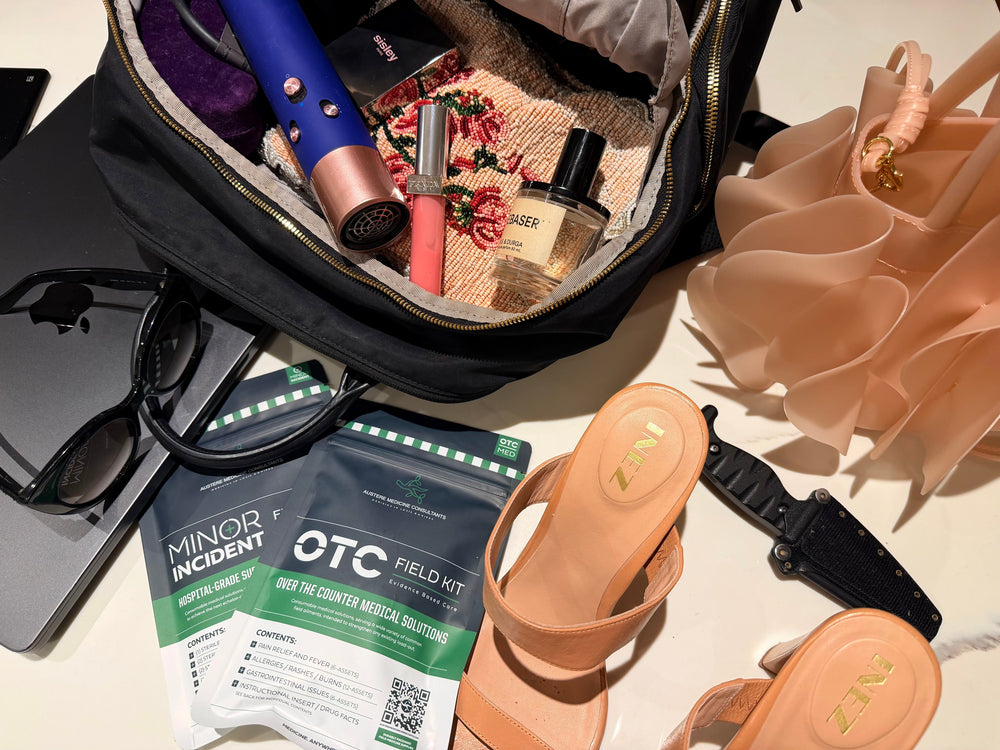
The Physician's Travel Medicine Kit List: What to Pack for Domestic, International, and Expedition Travel.
A physician's travel medicine kit list in three tiers: everyday, international, and austere. What to pack, what needs a prescription, and how to travel with it legally.
Read Article
Tele-Mentorship: Extending (and maintaining) the Standard of Care
Not Medical Advice The following discussion is educational and is not medical advice. It does not imply a physician-patient relationship, nor is anything discussed herein intended to advocate for any specific medical treatment or...
Read Article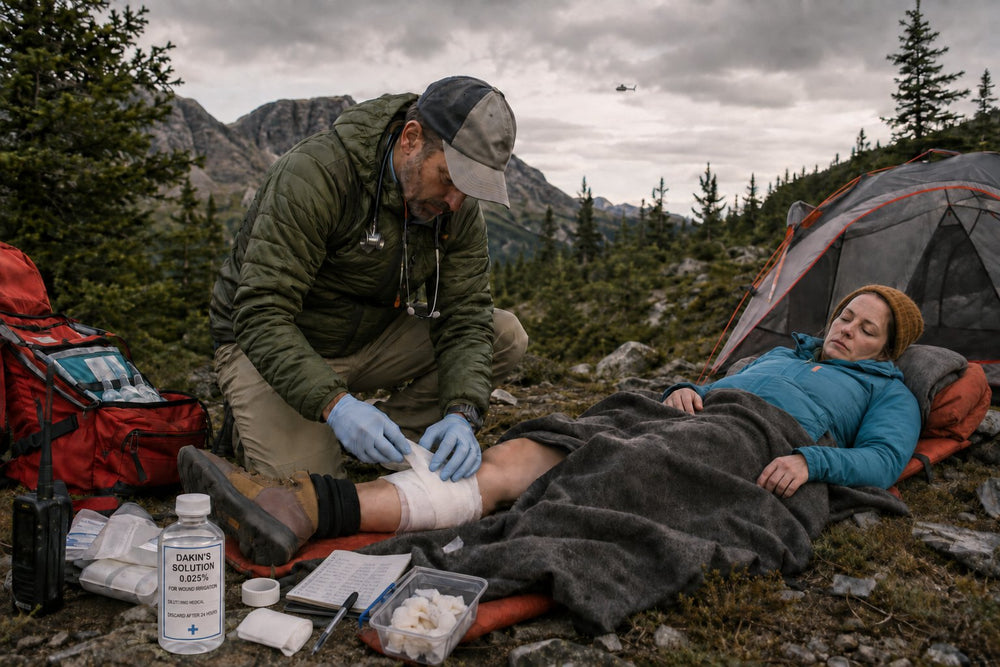
Wound Care in Austere Environments: A Framework
Cleaning, dressing, debridement, and Dakin's solution when evacuation is measured in days; a prolonged casualty care framework.
Read ArticleMedicine. Anywhere.
Austere Medicine Consultants brings hospital expertise and capability to the field. Explore physician-built kits engineered for the moments that matter.
Shop the Kits