

The following discussion is educational and is not medical advice. It does not imply a physician-patient relationship, nor is anything discussed herein intended to advocate for any specific medical treatment or therapy, or to replace standard accepted medical care by a trained healthcare professional. If you are injured or ill, seek immediate and definitive care from a licensed professional.
The Standard of Care Does Not Change
Trauma announces itself, mostly. Sepsis can be insidious in its progress until it's not.
Sepsis is the quiet killer of prolonged casualty care: an infection that outpaces the body while evacuation is delayed or denied. This Dispatch is about the discipline of treating sepsis in the field to the same standard we hold in the hospital, a single idea that helps organize how a forward provider should think about the septic patient: The surgery that saves them is not trauma care. It is source control, and source control is damage control surgery pointed at infection instead of bleeding.
This is the second installment of the AMC Austere Wound Care series. The first, Wound Care in Austere Environments: A Framework, covered cleaning, dressing, and debridement, and promised that antibiotics would be treated as an adjunct to source control "within our dispatch on sepsis." This is that Dispatch.
Austere Medicine Consultants was built by physicians who practice hospital medicine at the highest levels. Our premise is simple and, we think, non-negotiable: The standard of care is not a location. The environment changes what is possible; it does not change what is correct. What follows is how the current hospital standard for sepsis, including the 2026 Surviving Sepsis Campaign guidelines released this March, translates to the field, and where the surgeon's oldest reflex becomes the medic's most important one.
A new sofa? How do we recognize sepsis?

The progression of a limb infection does not always correlate to your SpO2 data or temperature. The earliest signs of sepsis from an infected wound are a spreading margin of redness, pain out of proportion to the wound, and firm, tense swelling, before the appearance of fever or a fast heart rate. In a fixed facility, we photograph and mark the advancing border by the hour. In the field, that same marked line, a pen on skin, is a legitimate, powerful monitoring tool that needs no battery.
NOTE: The figure(s) accompanying this Dispatch are generated and enhanced using AI to illustrate teaching principles. They are shared to teach recognition; no patient imagery is used in this series, as it is the policy of Austere Medicine Consultants and AMC Medicine LTD to adhere closely to HIPAA regulations, in the field or in the hospital.
Recent scholarly works, published earlier this Spring and filtering through academic circles, will begin to manifest in practical training and SOPs. In general, qSOFA is being replaced by the National Early Warning Score (NEWS) to detect early deterioration. For PCC, this translates to a 3-hour action window, microboluses with a feedback loop, moving away from Ertapenem to Ceftriaxone, and refining assessments to rule out trauma-related causes that masquerade as sepsis.
MEDICS AND PRACTITIONERS: Follow your SOPs and learn more at Sepsis Management in Prolonged Field Care
In-hospital care increasingly relies on AI monitoring of real-time data to provide an early warning system for patients at risk of developing or worsening sepsis. However, they have not replaced a Physician’s (or well-trained, licensed provider’s) bedside assessment and clinical acumen. Interestingly, CMS, the Centers for Medicare and Medicaid Services, still defines sepsis using the legacy SIRS-based framework AND pays hospital systems (or not) based on this outdated tool. But that is beyond the scope of this article.
Sepsis Is a battle unto itself
Sepsis is the body's dysregulated, life-threatening response to infection, in which the immune reaction itself begins to damage organs. On the modern battlefield and in every prolonged-care setting, it is a predictable second wave: The casualty who survives the first hour can still be lost on the third day to a wound that achieved hemostasis (bleeding control) but never cleared of infection. Operational analyses of the war in Ukraine describe exactly this pressure: evacuation delayed or denied, casualties held far forward long enough for infection to mature.
The hospital recognizes sepsis by a familiar pattern: a known or suspected infection plus signs of organ stress, such as rising heart rate, rising respiratory rate, confusion, low blood pressure, and low urine output. How do you know if you have sepsis when there is no laboratory? Sepsis recognition in an austere environment uses the same clinical picture without the lab: mental status, the feel of a pulse, the rate and effort of breathing, the color and warmth of the skin, and the trend over time. The single most important field skill in sepsis care is serial reassessment. The trend matters more than any one number.
For clinicians. The 2026 Surviving Sepsis Campaign guidelines recommend structured screening tools (NEWS, NEWS2, MEWS, or SIRS) over qSOFA as a single screening tool and reaffirm the core triad: early recognition, timely treatment of the infection, and hemodynamic resuscitation. The pillars survive the loss of the monitor. The tools we substitute must serve those same three ends.
Damage Control Was Never Only About Bleeding
Damage control surgery was born in trauma: stop the hemorrhage, pack and control microbleeding, and get the patient off the table alive to be resuscitated, then come back for definitive repair. Its content is a fundamental sequence: restore physiology first, accept an abbreviated operation, and plan the return.
Source control is damage control surgery aimed at infection. The "damage" you are controlling is the septic focus, and the clock is just as unforgiving as a bleeding one.
The 2023 international source-control guidelines make this explicit: In the physiologically deranged, septic patient, the surgeon should prioritize restoring physiology over anatomic restoration. Drainage, debridement, device removal, decompression, and deferred reconstruction, with a planned re-look. That summarizes the damage control algorithm, with infection in the place of hemorrhage. Framing source control as damage control surgery matters because it tells the forward provider that the septic patient is a surgical emergency, not a medical one to be managed with antibiotics alone.
This is the conceptual bridge we at Austere Medicine Consultants and AMC Medicine LTD feel every operator should cross. A medic trained in trauma damage control already owns the mental model. The task is to extend it: approach festering, necrotic tissue with the same urgency one would a junctional wound.
Source Control: The Surgery of Sepsis
Source control in sepsis is the physical elimination of the infection: draining pus, removing dead or infected tissue, taking out an infected device (bullet, dirt, bone fragments, etc.), and relieving any obstruction. Antibiotics and fluids buy time, but they do not clear a walled-off abscess or a mass of dead muscle. Roughly one in three patients with severe sepsis or septic shock requires a source-control procedure (32 percent of 3,663 patients in a 99-ICU Spanish cohort, most often for abdominal, urinary, and soft-tissue infections), and for them no amount of medical therapy substitutes for a procedure. This is the heart of sepsis treatment that a field provider must embrace.
Timing is paramount. The 2023 international source-control guidelines stratify it plainly: immediate emergent control for patients in severe physiologic derangement from a controllable source; urgent control within 1 to 24 hours for stable patients after resuscitation and antibiotics are administered; and delayed control only when waiting genuinely reduces surgical harm. The 2026 Surviving Sepsis Campaign now sets a target for the first time: early source control, ideally within 6 hours of diagnosing sepsis or septic shock that requires it. In septic shock from a perforated bowel, the evidence argues against "optimize first, operate later": in one series, survival fell to zero when surgery began more than six hours after admission.
The one that cannot wait: necrotizing fasciitis.
Necrotizing fasciitis and the other necrotizing soft-tissue infections, the "flesh-eating" infections, are the field's clearest example. The 2024 trauma-surgery literature is unambiguous that early, aggressive surgical debridement is the single most important determinant of survival. Antibiotics and critical care are adjuncts to the knife, never replacements. The casualty is taken back for planned repeat debridement, with a low threshold to return, until the tissue stops dying. That cadence, operate, resuscitate, re-look, is damage control by another name. Necrotizing fasciitis treatment without a surgeon is not a field option; it is the strongest possible argument for the earliest possible evacuation. We feel this is further evidence for initiatives that embrace integrating with and positioning local/organic medical providers trained in DCS and field-craft as close as feasible to FLOT.
Source Control at a Glance
- Drain what is closed, cut away what is dead, remove what is infected, relieve what is obstructed.
- Septic shock from a controllable source is an emergent surgical problem: minutes to a few hours, not a day. The 2026 target is within 6 hours.
- Necrotizing infection is debrided early and re-debrided on a planned schedule until it is clean.
- Abbreviate the operation to save the patient; defer definitive repair to the re-look.
- Antibiotics and fluids support source control. They never replace it.
OODA LOOPS IN THE FIELD
A single debridement is rarely enough. The figure in this Dispatch shows the cycle that defines both damage control and modern management of a necrotizing wound: the planned return. Necrotizing infections are re-explored on a planned schedule because dead tissue declares itself over time, and each look removes what has newly died.
In an austere setting, this is where discipline substitutes for equipment: a marked margin, a documented photograph, a fixed reassessment interval, and the will to go back in.

HOSPITAL GRADE RESUSCITATION, Adapted for the Field
The 2026 Surviving Sepsis Campaign guidelines carry several shifts that, by coincidence of physics and logistics, travel unusually well to the field, and they reshape sepsis fluid resuscitation for the provider who carries every liter on their back.
- Balanced crystalloids over saline. The current standard suggests balanced fluids over 0.9 percent saline. The practical field lesson is that fluid is heavy and finite, so every liter must be justified.
- Fluid-conservative is defensible. After the initial bolus, the septic shock fluid question was tested head-to-head in the CLOVERS trial: a restrictive, early-vasopressor strategy and a liberal-fluid strategy produced no difference in 90-day mortality. The 2026 guideline now allows either strategy once the initial crystalloid is in. Giving less fluid and starting blood-pressure support earlier is a safe, evidence-based approach to septic shock, which is fortunate, because crystalloid is scarce in the field.
- Early, peripheral vasopressors. Norepinephrine no longer waits for a central line. The 2026 guideline suggests starting vasopressors peripherally rather than delaying for central access, and a 2025 secondary analysis of CLOVERS found complications in fewer than 1 percent of peripheral starts, removing the single biggest barrier to bringing pressors forward.
- Steroids have a defined role. In a 2025 pooled analysis of 18 randomized trials, hydrocortisone reduced 28-day mortality in septic shock, with the strongest signal when combined with fludrocortisone. It is a conditional, adjunctive standard, not a first move.
- Ultrasound instead of a fixed number. Point-of-care ultrasound is proven feasible in austere environments and lets a provider titrate fluid to the patient. This is vital for the volume-sensitive heart-failure or dialysis casualty, where the danger is drowning the patient as much as under-filling them.
The volume-sensitive casualty. In patients with heart failure or end-stage kidney disease, harm tracks with cumulative fluid overload, not the initial resuscitation. The modern approach replaces the reflexive weight-based bolus with a feedback loop: a small, measured challenge, reassess with ultrasound and the physical exam, and escalate to vasopressors early rather than chase pressure with more fluid. As much as Doc loves aglio e olio, 30cc/kg of pasta water is not always the answer and who has room for that in thier ruck?
ANTIBIOTICS: TIMING AND STEWARDSHIP
The hospital standard is to give effective antibiotics immediately, within the first hour, for septic shock and for probable sepsis. The field standard mirrors it. Tactical Combat Casualty Care guidance calls for antibiotics on every open combat wound, and TCCC Change 25-1, published in 2025, replaced the previous agents: oral cefadroxil (or cephalexin as the alternative) for the casualty who can swallow, and parenteral ceftriaxone for the one who cannot. This is how to treat sepsis at its origin in the field: early, with the current agents, and never in isolation.
But the war in Ukraine has delivered a sobering caveat that every austere provider must internalize: Combat and prolonged-care wound infections are now dominated by multidrug-resistant bacteria, led by Acinetobacter baumannii. In one 2025 series from Ukraine, 84.6 percent of isolates were multidrug-resistant. The lesson is not to abandon early antibiotics; it is that no single field antibiotic can be trusted to save a limb or life on its own. Irrigation, debridement, and source control move from "adjunct" to "decisive." This is the clinical fact that most strongly validates the thesis of this Dispatch, and the reason the first installment of this series put cleaning and debridement before any drug.
The Standard of Care. Anywhere.
Everything above is basic medicine applied to field care. Austere Medicine Consultants and AMC Medicine LTD exist to deliver the standard of care one would receive in a US hospital to the patients that need it right now, wherever they are. Literally anywhere, as our motto, Medicina In Locīs Omnibus, implies.
Our physicians have spent careers at the bedside in inpatient and critical-care medicine, and we treat that experience as an obligation: to translate, faithfully what "the standard of care" demands when the CT scanner, blood bank, and operating room are hours or days away. And this is reinforced by our cadre of retired Army healthcare providers, Ranger Regiment and SF medics, and other, "field-experienced, subject matter experts".
An austere environment limits what is possible, but it does not lower the standard of what is correct. That standard is where we live.
Next in the Austere Wound Care series: the prolonged tourniquet problem, reassessment, conversion, and the cost of time.
Frequently Asked Questions
What are the signs of sepsis in the field?
Why is source control called the surgery of sepsis?
How is damage-control surgery related to sepsis source control?
How fast does source control need to happen in septic shock?
What is the most important treatment for necrotizing fasciitis?
How do you know if you have sepsis without lab tests?
How much IV fluid should you give in septic shock in the field?
Can vasopressors be given without a central line?
What antibiotics are used for wounds in the field?
How does AMC bring the hospital standard of care to austere settings?
References
- Prescott HC, Antonelli M, Alhazzani W, et al. Surviving Sepsis Campaign: International Guidelines for Management of Sepsis and Septic Shock 2026. Crit Care Med. 2026;54(4):725-812. doi:10.1097/CCM.0000000000007075
- Prescott HC, Antonelli M, Alhazzani W, et al. Surviving Sepsis Campaign: international guidelines for management of sepsis and septic shock 2026. Intensive Care Med. 2026;52(5):863-936. doi:10.1007/s00134-026-08361-1
- Coccolini F, Sartelli M, Sawyer R, et al. Source control in emergency general surgery: WSES, GAIS, SIS-E, SIS-A guidelines. World J Emerg Surg. 2023;18(1):41. doi:10.1186/s13017-023-00509-4
- De Waele JJ, Girardis M, Martin-Loeches I. Source control in the management of sepsis and septic shock. Intensive Care Med. 2022;48(12):1799-1802. doi:10.1007/s00134-022-06852-5
- Martínez ML, Ferrer R, Torrents E, et al. Impact of source control in patients with severe sepsis and septic shock. Crit Care Med. 2017;45(1):11-19. doi:10.1097/CCM.0000000000002011
- Azuhata T, Kinoshita K, Kawano D, et al. Time from admission to initiation of surgery for source control is a critical determinant of survival in patients with gastrointestinal perforation with associated septic shock. Crit Care. 2014;18(3):R87. doi:10.1186/cc13854
- Bisgaard EK, Bulger EM. Current diagnosis and management of necrotizing soft tissue infections: What you need to know. J Trauma Acute Care Surg. 2024;97(5):678-686. doi:10.1097/TA.0000000000004351
- National Heart, Lung, and Blood Institute PETAL Clinical Trials Network; Shapiro NI, Douglas IS, Brower RG, et al. Early restrictive or liberal fluid management for sepsis-induced hypotension. N Engl J Med. 2023;388(6):499-510. doi:10.1056/NEJMoa2212663
- Munroe ES, Co IN, Douglas I, et al. Peripheral vasopressor use in early sepsis-induced hypotension. JAMA Netw Open. 2025;8(8):e2529148. doi:10.1001/jamanetworkopen.2025.29148
- Ruyuan L, Zhangshun S, Hongling L, Jianling S. Corticosteroids for sepsis and septic shock: a meta-analysis of 18 RCTs with dose-stratified and fludrocortisone subgroup evaluation. BMC Anesthesiol. 2025;25(1):511. doi:10.1186/s12871-025-03388-1
- Beran A, Altorok N, Srour O, et al. Balanced crystalloids versus normal saline in adults with sepsis: a comprehensive systematic review and meta-analysis. J Clin Med. 2022;11(7):1971. doi:10.3390/jcm11071971
- Anderson A, Theophanous RG. Point-of-care ultrasound use in austere environments: a scoping review. PLoS One. 2024;19(12):e0312017. doi:10.1371/journal.pone.0312017
- Deaton TG, Drew B, Montgomery HR, Butler FK. Tactical Combat Casualty Care (TCCC) Guidelines: 25 January 2024. J Spec Oper Med. 2024;24(1):100-108. doi:10.55460/QT3B-XK5B
- Wisniewski P, Becker YA, Larson DT, et al. Antibiotics in Tactical Combat Casualty Care 2025: TCCC Change 25-1. J Spec Oper Med. 2025;25(4):85-93. doi:10.55460/SW7X-X8ZP
- Remley MA, Mosley D, Keenan S, et al. Committee on Tactical Combat Casualty Care (CoTCCC) position statement on prolonged casualty care (PCC): 01 May 2024. J Spec Oper Med. 2024;24(2):111-113. doi:10.55460/RWAU-AVBM
- Holubnycha VM, Kholodylo OV. War impact on antimicrobial resistance and bacteriological profile of wound infections in Ukraine. Commun Med (Lond). 2025;5(1):394. doi:10.1038/s43856-025-01056-6
- Joint Trauma System. Prolonged Casualty Care Guidelines (CPG ID:91). December 21, 2021. jts.health.mil (CPG 91 PDF)
- Joint Trauma System. Sepsis Management in Prolonged Field Care (CPG ID:83). October 28, 2020. jts.health.mil (CPG 83 PDF)
Educational content only. Guideline references (Surviving Sepsis Campaign, WSES/SIS, Joint Trauma System, and the Committee on Tactical Combat Casualty Care) are provided for context. Figures are licensed civilian photographs or illustrations; no patient imagery is used. This Dispatch is installment 2 of the AMC Austere Wound Care series.
More From Field Notes

Tele-Mentorship: Extending (and maintaining) the Standard of Care
Not Medical Advice The following discussion is educational and is not medical advice. It does not imply a physician-patient relationship, nor is anything discussed herein intended to advocate for any specific medical treatment or...
Read Article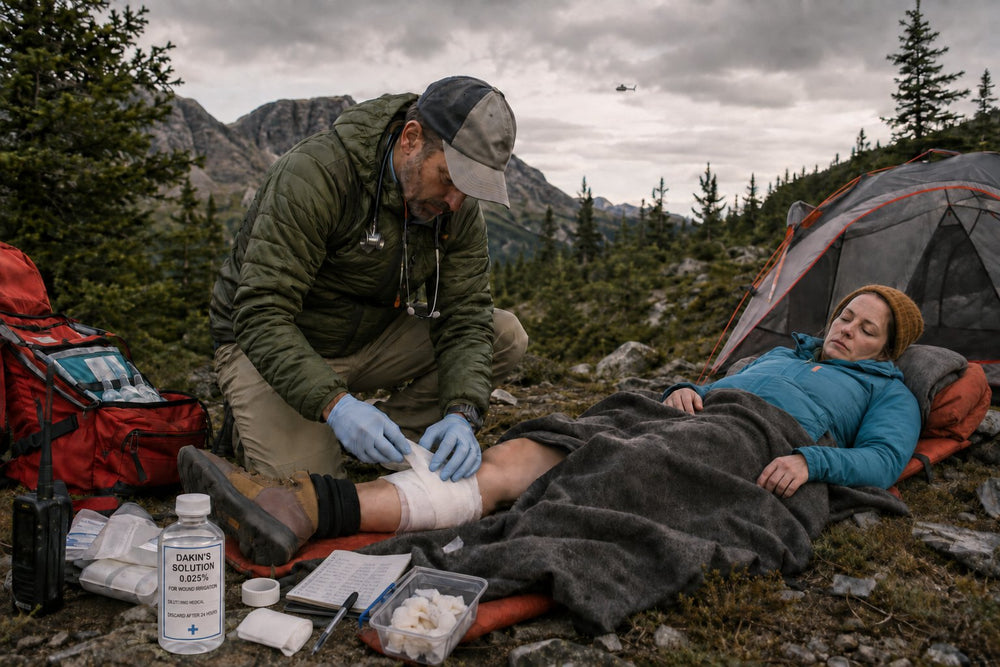
Wound Care in Austere Environments: A Framework
Cleaning, dressing, debridement, and Dakin's solution when evacuation is measured in days; a prolonged casualty care framework.
Read Article
Medical Threat and Capability Assessments: Scope, Deliverables, and When Your Organization Needs One
A first-aid kit is not a medical system. Neither is a telemedicine subscription, an evacuation plan, or a staff member with medical training.
Read ArticleMedicine. Anywhere.
Austere Medicine Consultants brings hospital expertise and capability to the field. Explore physician-built kits engineered for the moments that matter.
Shop the Kits